
Review by: Úna Nic Cárthaigh
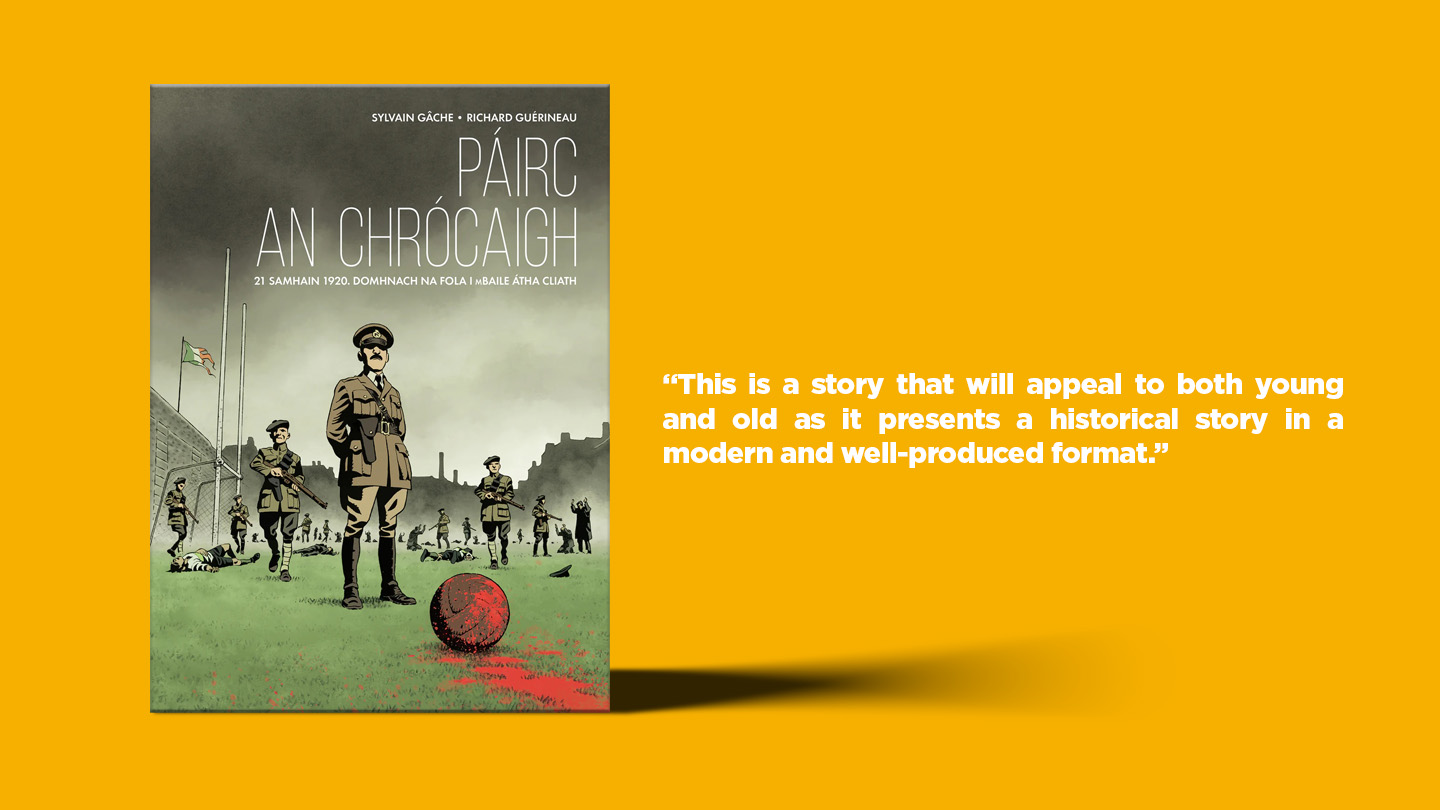
This graphic novel gives us the background to the historical event of Bloody Sunday which took place on 21 November 1920 in Croke Park when 14 people were killed with a number of others injured. The story begins in 2007 during the Six Nations Cup where we meet a French rugby fan who is in Dublin for the Ireland-France game. He meets two elderly men in the pub who are discussing the historical significance of Ireland playing England in a rugby game in Croke Park in a fortnight’s time, with lots of apprehension and trepidation around that event. The French fan asks them to explain the significance of the event, and the two men take us down memory lane recalling that fateful day and the events leading up to it.
They bring us back to the 20 November 1920 where GAA fans from Tipperary are making their way to Dublin to attend the challenge match between Tipperary and Dublin. The tension between the Irish and English is showed plainly as a fight breaks out on the train. We see the fashion and vernacular speech of the time which adds to the story’s authenticity and realism. Then we are shown the branch of the IRA, headed by Michael Collins and known as The Twelve Apostles, who kill a team of British undercover officers (The Cairo Gang) whose aim was to eliminate the Irish independence movement. The police division known as the Black & Tans were confident that The Twelve Apostles would be at the game in Croke Park and opened fire, killing innocent civilians.
The story ends back in 2007 with a description of the rugby game between Ireland and England when there is some historical reconciliation between the two nations. It is effective and interesting to go from reading the historical context of Bloody Sunday to live commentary of the modern game and this really makes the significance of it all the more apparent. Antain Mac Lochlainn has translated it beautifully with liveliness and pace, while keeping the authentic tone of speech in 1920s Ireland. The illustrations are vivid and the two timelines of 2007 and 1920 are excellently depicted.
This is a story that will appeal to both young and old as it presents a historical story in a modern and well-produced format. The Irish is clear and learners of the language will be able to understand it. One for the coffee table and all ages!