Review by: Úna Nic Cárthaigh
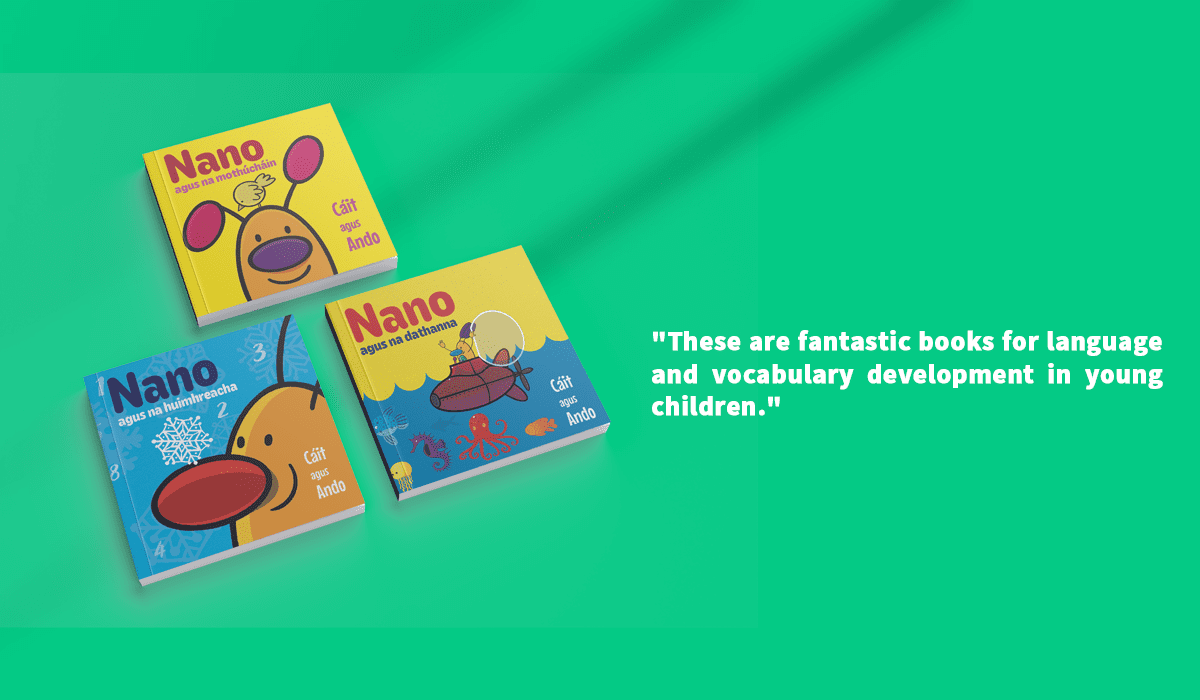
Here is a fantastic new series of boardbooks with three books (so far): Nano agus na huimhreacha (Nano and the numbers), Nano agus na dathanna (Nano and the colours) agus Nano agus na mothúcháin (Nano and the feelings).
These books are ideal for young children in their simplicity, the learning opportunities they provide, their beautiful bright illustrations and sturdy design. They are small square board books which will withstand little hands and teeth and there are lots of bright, primary colours with a strong theme of yellow, blue and red throughout.
In each book we follow the main character Nano – a yellow oval cartoon character with antenna-like ears and oval nose that changes colour from book to book and as his mood changes. As is synonymous with Andrew Whitson’s artistic style (or Mr Ando as he is also known) there are thick black lines which show Nano’s facial expressions perfectly.
These are fantastic books for language and vocabulary development in young children. In the book Nano agus na huimhreacha, the reader counts from nought to ten with Nano, each number having its own double-page spread and the number represented in both digit and text. As Nano sits on the branch of a tree, snowflakes begin to fall which increase with the numbers until Nano is left with a blanket of snow underneath him. A brilliant book for learning to count.
In the book Nano agus na dathanna, we learn about ten colours which are written and shown clearly on each double page spread. In this story, Nano dives underwater in his submarine in search of sea creatures. He meets many animals including fish, seahorse, jellyfish and narwhal, with each having a different colour. There is a handy glossary of the names of the sea creatures at the start of the book that will help parents and guardians when reading.
In the book Nano agus na mothúcháin, we see Nano experiencing eleven emotions which are represented clearly through his facial expressions, brilliantly illustrated by Mr Ando and also through the clear and concise language by author Caitríona Nic Sheáin. There are the more commonly known emotions such as ‘Tá brón ar Nano’, ‘Tá áthas ar Nano’ and also lesser known ones such as ‘Tá Nano trína chéile’ and ‘Tá Nano ar bís’. The emotions are shown not only through Nano’s facial expressions but also through a group of little birds who watch and react to Nano’s changing moods. It is so important for young children to have the language to explain how they’re feeling and this book is the perfect resource for that.
These are such effective books for young children and I’m looking forward to seeing more in the series. There is a QR code at the back that brings readers to a Vimeo recording of the books in the three dialects of Ulster, Munster and Connacht Irish, a clever resource provided by the publishers An tSnáthaid Mhór.